



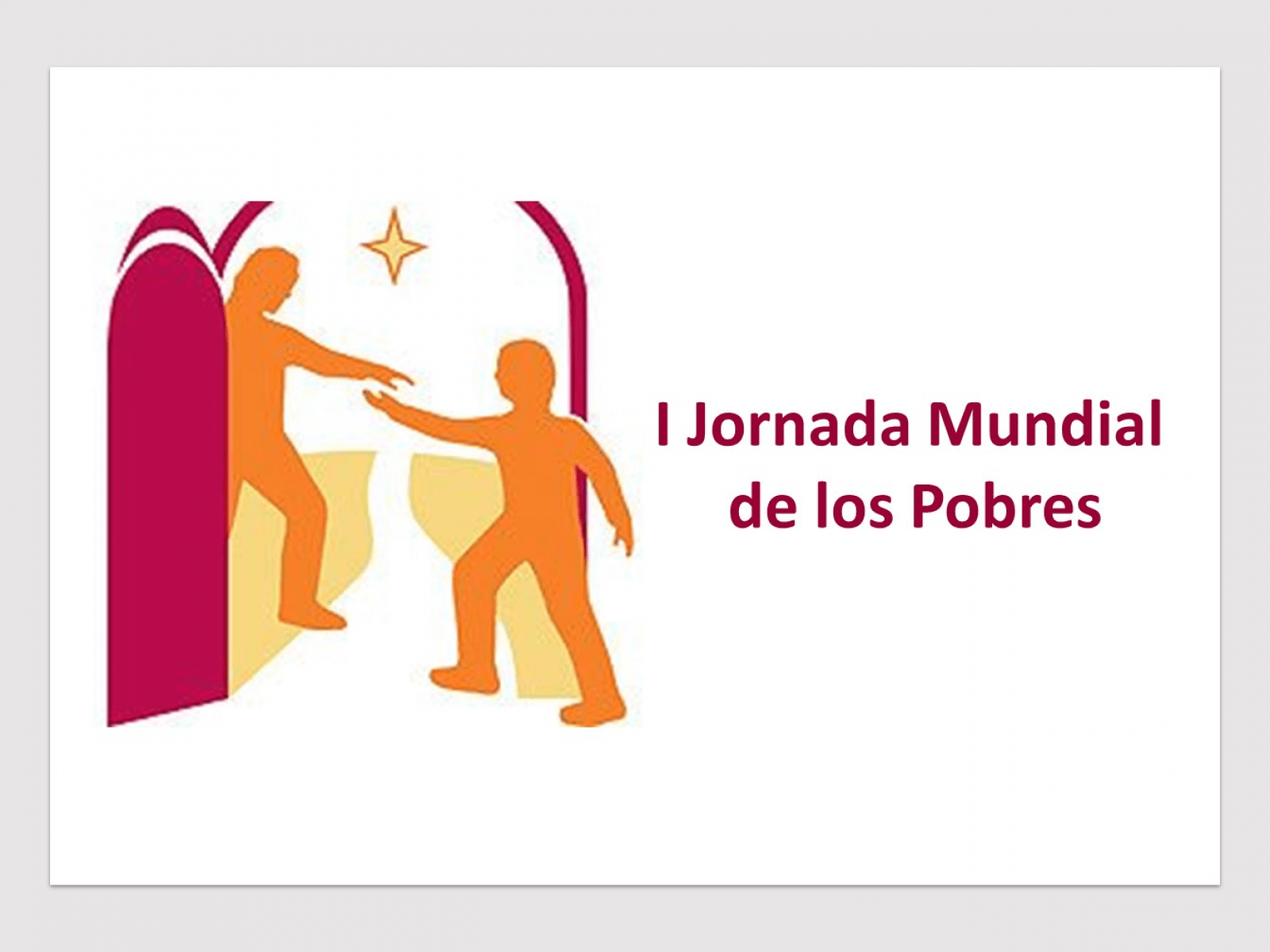
MESSAGE OF HIS HOLINESS POPE FRANCIS FOR THE FIRST WORLD DAY OF THE POOR 33rd Sunday in Ordinary Time
19 November 2017
Let us not love in word but in action 1. “My little children, let us not love in word or speech but in truth and action” (1 Jn 3:18). These words of the Apostle John express an imperative that no Christian can ignore. The seriousness with which the “beloved disciple” has handed down Jesus’ command to us to this day is made all the more intense by the contrast he perceives between the empty words often on our lips and the concrete actions we are faced with. Love admits no excuses: whoever wants to love as Jesus loved must make his example his own, especially when it comes to loving the poor. On the other hand, we know well the way the Son of God loved, and John clearly recalls it. It is based on two pillars: God loved us first (cf. 1 Jn 4:10, 19); and he loved us by giving everything, even his own life (cf. 1 Jn 3:16). Such love cannot go unanswered. Although it was given unilaterally, that is, without asking for anything in return, it nevertheless so inflames the heart that every person feels impelled to reciprocate, despite his limitations and sins. And this is possible to the extent that we welcome into our hearts the grace of God, his merciful charity, in such a way that it moves our will and even our affections to love God himself and our neighbor. Thus, the mercy that, so to speak, springs from the heart of the Trinity can move our lives and generate compassion and works of mercy in favor of our brothers and sisters in need. 2. “If the afflicted call upon the Lord, he hears” (Ps 34:7). The Church has always understood the importance of this call. This is clearly evident from the first pages of the Acts of the Apostles, where Peter asks that seven men be chosen “full of the Spirit and wisdom” (6:3) to take charge of assisting the poor. This is undoubtedly one of the first signs with which the Christian community presented itself on the world scene: service to the poorest. This was possible because it understood that the life of Jesus’ disciples had to be manifested in a fraternity and solidarity that corresponded to the Master’s principal teaching, who proclaimed the poor as blessed and heirs of the Kingdom of Heaven (cf. Mt 5:3). “They sold their possessions and goods and distributed them among all, as each had need” (Acts 2:45). These words clearly show the deep concern of the first Christians. The evangelist Luke, the sacred author who has devoted the most space to mercy, describes without rhetoric the sharing of goods in the first community. With this he wishes to address believers of every generation, and therefore also us, to support us in our testimony and encourage us to act in favor of those most in need. The apostle James expresses this same teaching in his letter with equal conviction, using strong and incisive words: “Listen, my dear brothers: Has not God chosen the poor of the world to make them rich in faith and heirs of the kingdom he promised to those who love him? But you have dishonored the poor. And yet, is it not the rich who lord it over you and drag you into court? […] What good does it do, my brothers, if someone says he has faith but does not have works? Can faith save him? Suppose a brother or sister goes without clothes and food, and one of you says to them, ‘God help you, keep warm and fill your bellies,’ and you do not give them the things they need for their bodies. What good is it? This is the case with faith: if it does not have works, it is dead by itself” (2:5-6, 14-17). 3. There have been times, however, when Christians have not fully heeded this call, allowing themselves to be contaminated by a worldly mentality. But the Holy Spirit has not ceased to exhort them to fix their gaze on what is essential. He has indeed raised up men and women who in many ways have given their lives in the service of the poor. How many pages of history, in these two thousand years, have been written by Christians who, with all simplicity and humility, and with the generous genius of charity, have served their poorest brothers and sisters. Among them stands out the example of Francis of Assisi, who has been followed by many saints throughout the centuries. He was not content with embracing and giving alms to lepers, but decided to go to Gubbio to be with them. He himself saw in that encounter the turning point of his conversion: “When I lived in sin, it seemed very bitter to me to see the lepers, and the Lord himself led me among them, and I treated them with mercy. “And as I turned away from them, what had seemed bitter to me became sweetness of soul and body” (Test 1-3; FF 110). This testimony shows the transforming power of charity and the Christian way of life. Let us not think of the poor only as the recipients of a good voluntary work to be done once a week, and even less of improvised gestures of good will to ease our conscience. These experiences, while valid and useful in raising our awareness of the needs of many brothers and sisters and of the injustices that often cause them, should introduce us to a true encounter with the poor and give rise to a sharing that becomes a way of life. In fact, prayer, the path of discipleship and conversion find in charity, which is transformed into sharing, the proof of its evangelical authenticity. And this way of life produces joy and spiritual serenity, because one touches the flesh of Christ with one’s hand. If we truly wish to encounter Christ, we must touch his body in the wounded bodies of the poor, as a confirmation of the sacramental communion received in the Eucharist. The Body of Christ, broken in the sacred liturgy, allows itself to be found through shared charity in the faces and persons of the weakest brothers and sisters. The words of the saintly Bishop Chrysostom are always relevant: “If you wish to honour the body of Christ, do not despise it when it is naked; do not honour the Eucharistic Christ with silken vestments, while outside the temple you neglect that other Christ who suffers from cold and nakedness” (Hom. in Matthaeum, 50,3: PG 58). We are therefore called to reach out to the poor, to meet them, to look them in the eye, to embrace them, to make them feel the warmth of love that breaks the circle of loneliness. His outstretched hand towards us is also a call to leave behind our certainties and comforts, and to recognize the value of poverty in itself. 4. Let us not forget that for Christ’s disciples, poverty is first and foremost a vocation to follow the poor Jesus. It is a journey behind him and with him, a path that leads to the happiness of the kingdom of heaven (cf. Mt 5:3; Lk 6:20). Poverty means a humble heart that knows how to accept its own condition as a limited and sinful creature in order to overcome the temptation of omnipotence, which deceives us into believing ourselves to be immortal. Poverty is an attitude of the heart that prevents us from considering money, a career, luxury as the goal of life and the condition for happiness. It is poverty, rather, that creates the conditions for us to freely assume our personal and social responsibilities, despite our limitations, trusting in God’s closeness and supported by his grace. Poverty, thus understood, is the measure that allows us to value the proper use of material goods, and also to live our ties and affections in a generous and selfless way (cf. Catechism of the Catholic Church, nn. 25-45). Let us therefore follow the example of St. Francis, a witness to authentic poverty. Precisely because he kept his eyes fixed on Christ, he was able to recognize him and serve him in the poor. If we wish to offer our effective contribution to changing history, generating real development, we must listen to the cry of the poor and commit ourselves to lifting them out of their situation of marginalization. At the same time, I remind the poor who live in our cities and communities not to lose the sense of evangelical poverty that is imprinted on their lives. 5. We know how difficult it is in the contemporary world to clearly identify poverty. However, it challenges us every day with its many faces marked by pain, marginalization, oppression, violence, torture and imprisonment, war, deprivation of freedom and dignity, ignorance and illiteracy, health emergencies and lack of work, human trafficking and slavery, exile and misery, and forced migration. Poverty has the face of women, men and children exploited by vile interests, trampled underfoot by the perverse logic of power and money. What an endless and cruel list we find when we consider poverty as the fruit of social injustice, moral misery, the greed of a few and widespread indifference. Today, unfortunately, as the shameless wealth that accumulates in the hands of a privileged few, often accompanied by illegality and the offensive exploitation of human dignity, increasingly emerges, the spread of poverty in large sectors of the entire society is scandalous. Faced with this scenario, we cannot remain inactive, nor resigned. To the poverty that inhibits the spirit of initiative of many young people, preventing them from finding work; to the poverty that dulls the sense of responsibility and induces a preference for delegation and the pursuit of favouritism; to the poverty that poisons the sources of participation and reduces the spaces for professionalism, thus humiliating the merit of those who work and produce; all this must be responded to with a new vision of life and society. All these poor, as Blessed Paul VI used to say, belong to the Church by “evangelical right” (Address at the opening of the second session of the Second Vatican Ecumenical Council, 29 September 1963) and compel a fundamental option for them. Blessed are the hands that open to welcome the poor and help them: they are hands that bring hope. Blessed are the hands that overcome the barriers of culture, religion and nationality, pouring the oil of consolation on the wounds of humanity. Blessed are the hands that open without asking for anything in return, without “buts” or “conditions”: they are hands that bring down God’s blessing upon their brothers and sisters. 6. At the end of the Jubilee of Mercy, I wished to offer the Church the World Day of the Poor, so that throughout the world Christian communities may become ever more concrete signs of Christ’s love for the least and most needy. I would like to add this one to the other World Days established by my predecessors, which are already a tradition in the life of our communities, which brings a delicately evangelical element that completes them all, namely, Jesus’ predilection for the poor. I invite the whole Church and men and women of good will to keep their gaze fixed on those who stretch out their hands in cry for help and in demand of our solidarity. They are our brothers and sisters, created and loved by the heavenly Father. This Day aims first of all to encourage believers to react against the culture of waste and squandering by making the culture of encounter their own. At the same time, the invitation is addressed to all, regardless of their religious confession, to be ready to share with the poor through every act of solidarity, as a concrete sign of fraternity. God created heaven and earth for all; it is men, unfortunately, who have raised borders, walls and fences, betraying the original gift destined for humanity without any exclusion. 7. It is my hope that Christian communities, in the week preceding the World Day of the Poor, which this year falls on 19 November, the 33rd Sunday in Ordinary Time, will commit themselves to organizing various moments of encounter and friendship, of solidarity and concrete help. They can invite the poor and the volunteers to participate together in the Eucharist on that Sunday, in such a way that the celebration of the Solemnity of Christ the King of the universe on the following Sunday may be more authentically manifested. In fact, the kingship of Christ emerges in all its most genuine meaning on Golgotha, when the Innocent One nailed to the cross, poor, naked and deprived of everything, embodies and reveals the fullness of God’s love. His complete abandonment to the Father expresses his total poverty, while making evident the power of this Love, which raises him to new life on Easter Day. On this Sunday, if there are poor people in our neighbourhood who ask for protection and help, let us approach them: it will be the opportune moment to encounter the God we are seeking. In accordance with the teaching of Scripture (cf. Gen 18:3-5; Heb 13:2), let us seat them at our table as guests of honour; they can be teachers who help us to live our faith in a more coherent way. With their trust and willingness to allow themselves to be helped, they show us in a sober and often joyful way how important it is to live with what is essential and to abandon ourselves to the providence of the Father. 8. The foundation of the various concrete initiatives that will be carried out during this Day will always be prayer. We must not forget that the Lord’s Prayer is the prayer of the poor. The request for bread expresses trust in God for the basic needs of our life. Everything that Jesus taught us with this prayer manifests and takes up the cry of those who suffer because of the precariousness of existence and the lack of necessities. To the disciples who asked Jesus to teach them how to pray, he responded with the words of the poor who turn to the one Father in whom all recognize themselves as brothers. The Our Father is a prayer said in the plural: the bread asked for is “ours,” and this implies communion, concern and common responsibility. In this prayer we all recognize the need to overcome every form of selfishness in order to enter into the joy of mutual acceptance. 9. I ask my brother bishops, priests, deacons who have the vocation of helping the poor, consecrated persons, associations, movements and the vast world of volunteer work to commit themselves to ensuring that this World Day of the Poor establishes a tradition that is a concrete contribution to evangelization in the contemporary world. May this new World Day become a strong call for our believing conscience, so that we may be ever more convinced that sharing with the poor enables us to understand the Gospel in its deepest truth. The poor are not a problem, but a resource to which we can turn in order to welcome and live the essence of the Gospel.
Vatican, June 13, 2017 Memorial of Saint Anthony of Padua
Francis
Summer with Faith: Caring for Our Elderly and Children During the Holidays
As summer arrives, plans, holidays, and well-earned rest begin to take center stage. Yet summer also has another side—one that often goes unnoticed but is just as real: the loneliness experienced by many older people during this time of year, and the growing...