







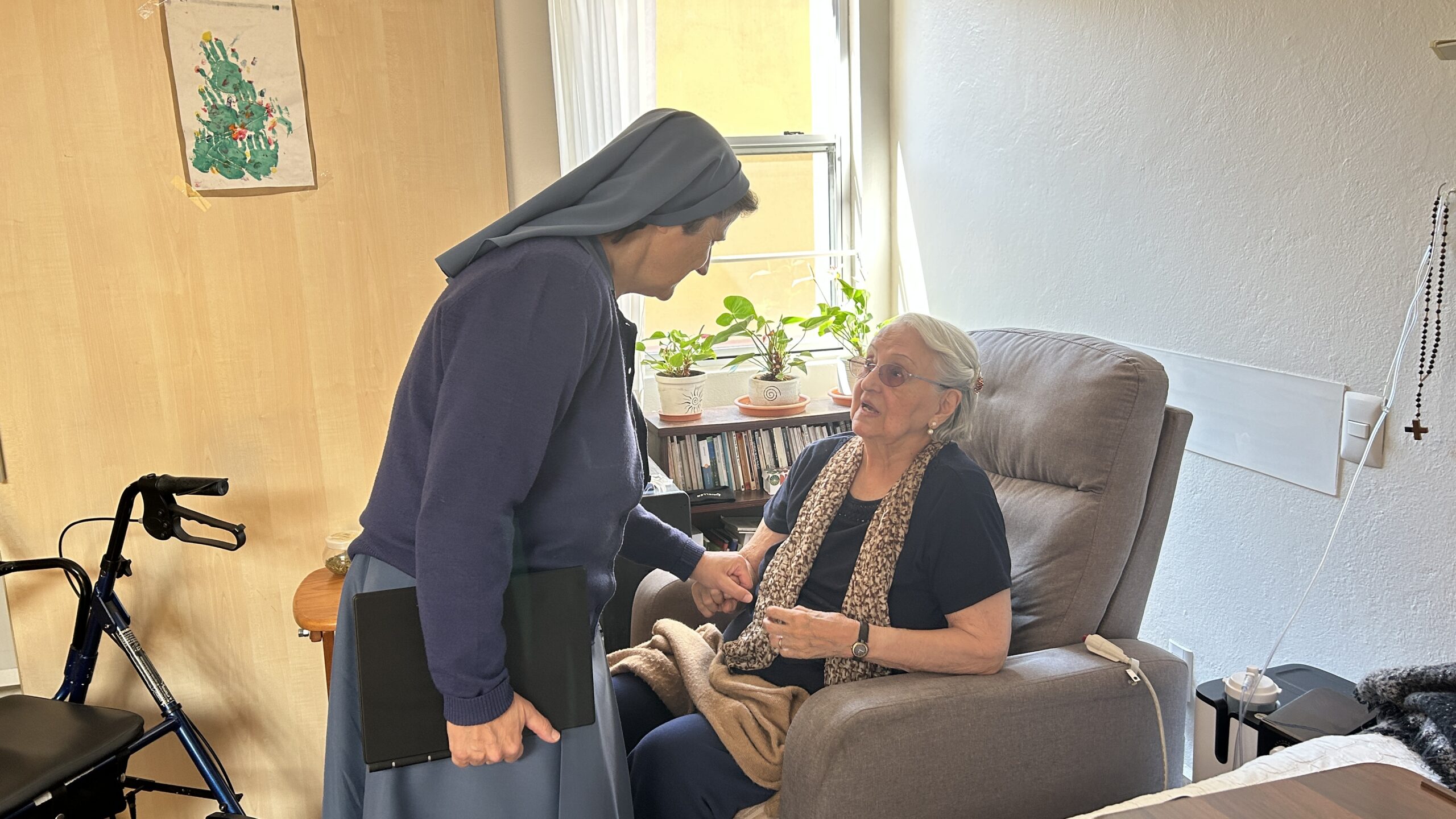
The Spanish Government has recently approved the first National Strategic Framework on Loneliness (2026–2030), a strategy that aims to coordinate public authorities, the community sector and the third sector to provide structural solutions to a problem which, according to the National Observatory on Unwanted Loneliness, affects 20 per cent of the Spanish population, who feel lonely through no fault of their own. Of these, two-thirds have been living in this situation for more than two years, with an impact that particularly affects older people and is associated with a lower life expectancy. Globally, the World Health Organisation estimates that One in six people experience unwanted loneliness.
These figures describe, in statistical terms, something that our congregation has been seeking to address for over a century through the language of the Gospel. Our charism has a name of its own: to be a source of comfort in times of loneliness, in which we are inspired by the witness of Jesus’ merciful heart, which seeks in all things the greater glory of God, the salvation of humankind and our own sanctification, and in which we live a consecrated life within a community of faith, fraternal love and apostolic service.
This vocation has its roots in a very specific image: that of the Guardian Angels who protect, support and look after. And that is our true wish: to be true angels who comfort and accompany Jesus in the suffering He continues to experience in those who are lonely and in need, just as the Guardian Angels themselves, who, whilst serving humankind, continually contemplate the face of the Father.
A vocation in which contemplation leads us to service and service leads us to contemplation, and in which Mary, standing at the foot of the Cross, is a model of that closeness to those who suffer. That is why, when current events bring national figures and strategies to the fore today, this is nothing new to us; rather, It is the very reason for our mission.
In our care homes, we welcome, support and care for – both physically and spiritually – women who live in isolation or who are most in need of help and comfort; we also look after children and young people who are going through this painful experience – that is to say, we are there wherever someone needs to be listened to, accompanied, supported and comforted; and I would add: where others do not reach, to support those whom no one else supports. As those who are currently working to combat unwanted loneliness also point out, There is no single type of loneliness; rather, unfortunately, there is a wide range of forms of loneliness: that of older people, the largest group; that of people with disabilities; that of young people, who are feeling it ever more keenly in the wake of digitalisation; that linked to loss and bereavement; and that of those who, as homeless people, experience it in the most extreme way.